Showing posts with label station. Show all posts

Thursday, April 11, 2024

Jesus in the Garden of Gethsemane

Each year, for about the last ten, I have participated in a Lenten practice, creating one of the Stations of the Cross. 

Stations of the Cross are a series of 14 (or more) pictures of Jesus' journey, as represented in Holy Week prior to Easter. Just ahead of Lent, a member of my church puts out a call for volunteers to create the stations, the only restriction being the 24" x 30" size. The series is hung in the church nave during Holy Week and they remain in place until the next year's call for art goes out the the church members.

Various media are used - collage, acrylic paint, oil paint, other inks and paints, photographs, and small scuptural pieces that will fit on a 24x30 frame. With one exception, mine have been fabric pieces, sort of small quilts, though none of mine really fit the strict definition of a quilt. I sew the piece onto a painted canvas.

In progress, after the hollowing out.

Each year, it is a struggle. Yet each year, I sign up again and begin the struggle. I believe this is an important Lenten journey for me, the struggle, the goofs, the final piece.

a test

This year I chose Jesus in the Garden of Gethsemane, an event that appears in all four of the New Testament Gospels. I began with the scriptural stories and also recalled my own visit to the Garden of Gethsemane. I imagined. I sketched. I sewed. I unsewed.

Before he was hollowed out.

Materials: 

During fall 2023, I took an intensive online course from Jane Dunnewold. The title was Color Mastery: from White to Wow. I used unbleached silk noil and Pro MX fiber reactive dyes. I am also working my way through 2024 with a YouTuber, k3n Cloth Tales. I had some eco-prints and dyes inspired by her work.

Process:

I started with the background in three segments - sky, Jerusalem skyline, and the garden itself in the foreground. The sky is raw-edge applique with an invisible stitch, to start. I really like raw-edge work because it avoids the lumps caused by seams. On the other hand, I wanted the *lumps* on standard needle-turn applique for the Jerusalem skyline, in order to articulate buildings. And the ground for the garden is also (mostly) needle-turned applique.

another test.

Creating the foreground was the most challenging for me. The story is complex so there were many ways to go. I tried out pictures of sleeping figures.

Yet another test.

I created a super-sized figure that I placed over the background, a Jesus-figure. After I appliqued the figure on and added decorative embroidery to the edge, I decided it was all wrong. So I next cut out the center. Church friend, Margaret, pointed out that, in the story, Jesus was hallowed out by his anguish. Thank you, Margaret.

Background

Then I created some bias tubes and began to form the olive branch vines and leaves. Gethsame literally translates Olive Press. And today's garden is full of olive trees.

Building up the background on cotton flannel

After that, I added embroidery to highlight and support various aspects of the piece. For example, I outlined the buildings to give them a bit of depth, adding a few details.

I was hand-stitching almost non-stop in the lead-up to Holy Week. It was such a relief to finish and be completely ready for Holy Week. The church held a *Starving Artists* dinner of soup and bread. Each artist described their journey in creating their art piece. It was a beautiful event.

St Patrick's publishes a nice pamphlet with write-ups on each station. Here is a photo of three. The one on the far right is by my wonderful granddaughter, H. This is their second year on this Lenten journey.


If you celebrate, then Happy Easter! Happy spring and Happy sewing!

Thursday, April 6, 2023

Station 5

This year, I chose Station 5, Pilate Judged Jesus, as my contribution to the Stations of the Cross, produced annually by the artists in my church. It is not one of the more traditional 14 stations. Our volunteer coordinator, Margaret, pushed us to produce 28 (!) stations by combining the traditional list with others introduced by a pope, I believe. 

Side note - can you imagine *coordinating* 28 artists?


One of the aspects of this annual ministry that I dearly love is that we acknowledge that everyone is an artist! All ages, all *skill* levels, all who claim they cannot draw, and so on. The only requirement is that it fit on a 24" x 30" canvas with a wire on the back for hanging in our church nave.

As usual, I sketched, fussed, trolled the internet, fussed, and sketched some more. A few days before our presentation at the Starving Artists' soup supper, DH asked me if I was finished. I replied that I was either almost finished or about to start over.


That is because I decided to add some paint. I knew that it would be either done or ruined. Spirit led me to done. Of course, it is always hard to say it's done. Maybe I should add this or that. A deadline has a way of reining me in. 


There are many layers to the story of Pilate judging Jesus. Herod refused to judge Jesus and sent the decision back to Pilate, a local Roman official. Pilate saw the mine field involved in judging this charismatic and spiritual Jesus. So Pilate turned it over to the people. And we all know what the people did. Just like Herod, just like Pilate, they turned their backs on Jesus.


My meditation for this is to wonder when I have turned my back on someone. I still have lots to ponder there. I sat with that thought throughout Lent. And I'm still sitting with it, praying I will be more open to the needs of people I encounter.


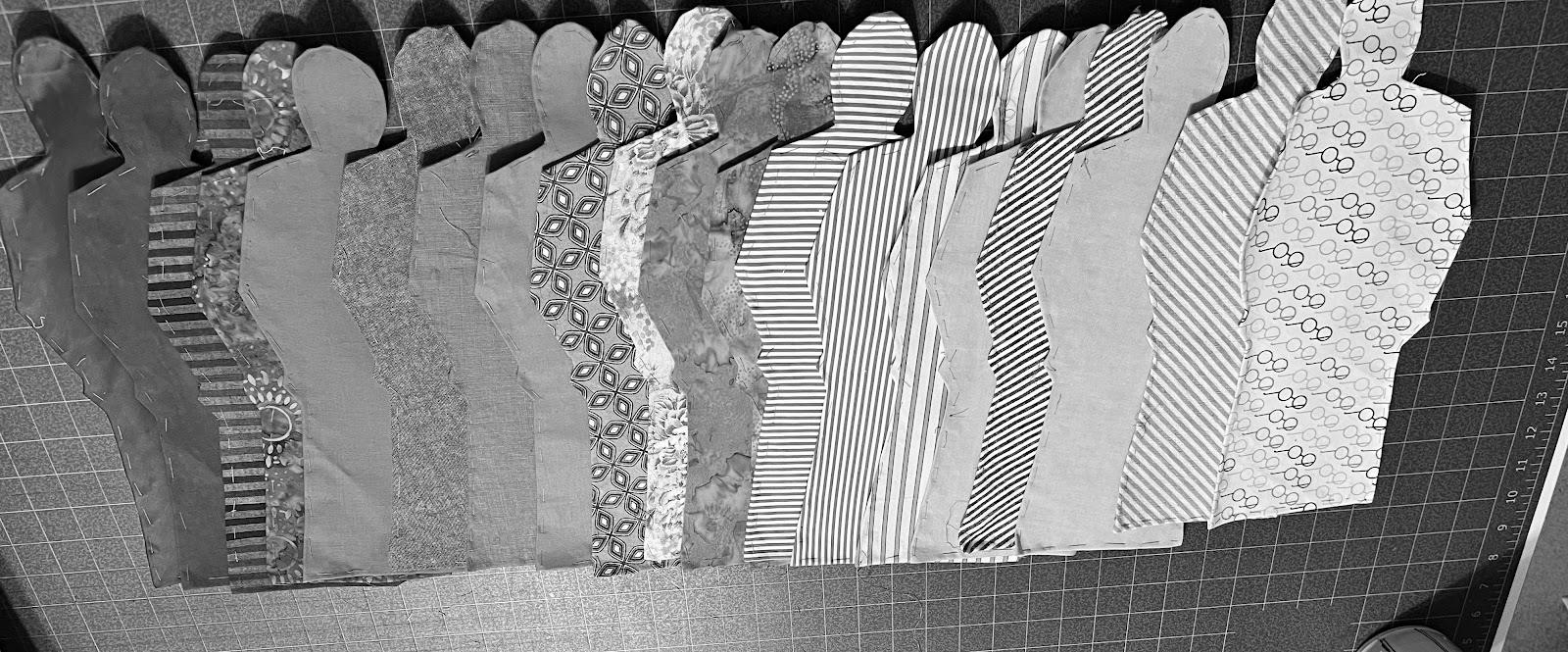
The quilt is composed of appliqued shapes of people from the back, silhouettes, really. I used remnants from various sewing projects and varied the contrast so that the upper figures read as fading into the background. The idea was to show lots of people turning their backs on Jesus.


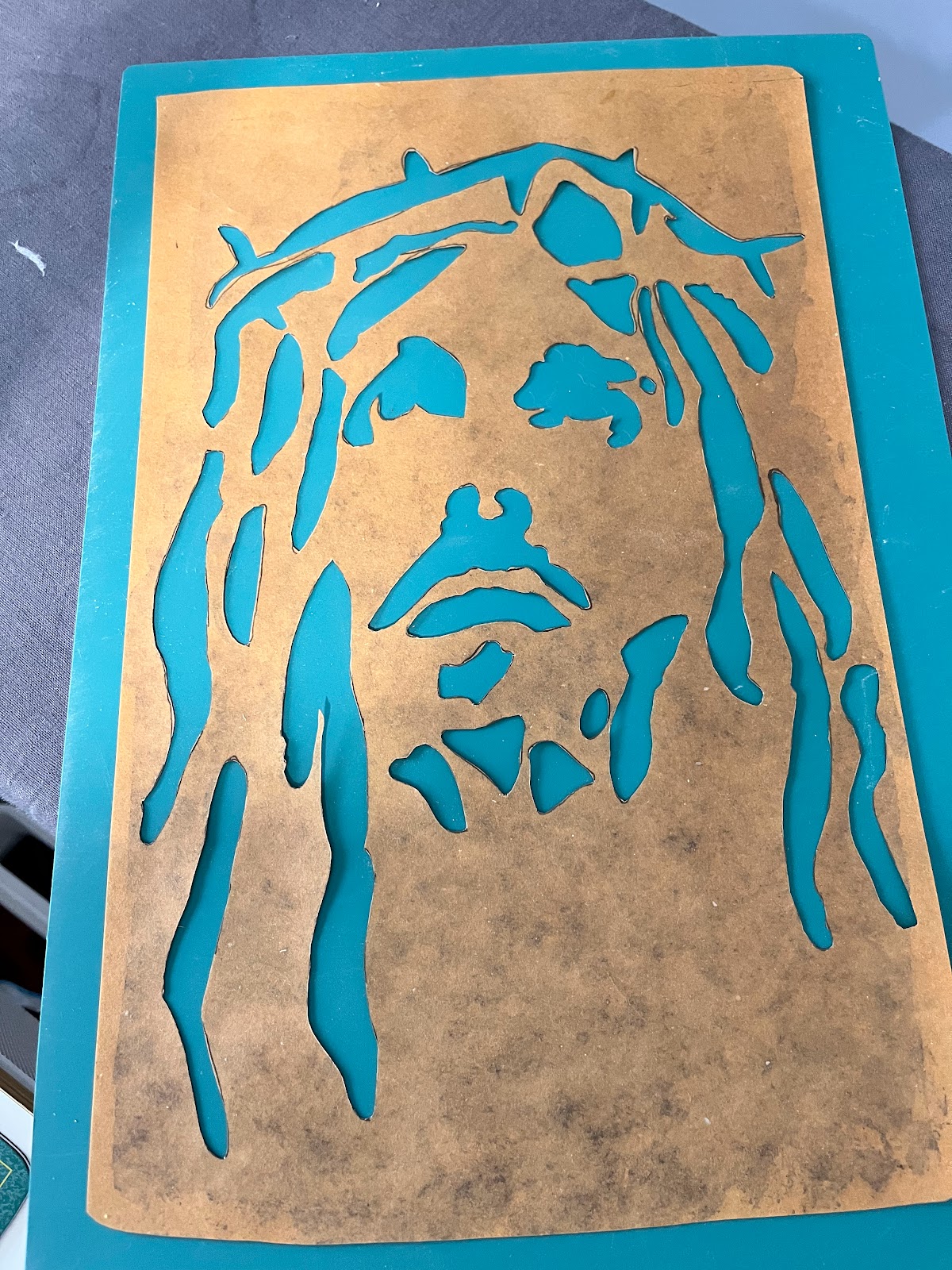
After much gnashing of teeth, I decided to cut a stencil of Jesus based on an image I found online. I never could find a source for the original image, as it only appeared on someone's Pinterest page without a link to the original. It was just right for my idea.


First I printed it on my printer in 8x11 format. Then I enlarged it 175% on the printer in sections. Next I taped the pages together and, using a light box, traced it onto some wonderful stencil paper I purchased from Roland Ricketts. I have no idea what that stencil paper is called, but I enjoyed working with it. It has been sitting in my stash for years. It was nice to finally use it.


The next step was to cut with an exacto knife. That was back-breaking, even using my raised cutting table. Luckily DH has a work table adjusted for his much-taller height. That allowed me to cut the stencil without the awkward curve in my back. It still took a long time but the result was and is very satisfying. I love that stencil.


It occurred to me that the back of my quilt would be a nice test spot for the paint. The fact that the surface is quilted in long fluid lines created a surface not ideal for use of a stencil. I pressed it as flat as I possibly could and taped it to the table. Then I taped the stencil to the quilt. Next I placed my blank screen over it and applied fabric paint to it using an old credit card. It worked.


After the back dried, I did the same to the front. Again the paint sank into the crevices formed by the quilting, but I decided to like the effect. I was done!


This year, I attached the quilt to the canvas with hook-and-loop tape, applying a glue-backed hook strip to the canvas. I attached some sew-in loop tape to a strip of fabric and hand-stitched it to the back of the little quilt. That way, I can remove it and add a sleeve later for hanging in my sewing space.

And I like it quite a lot. And it's done. And it has been hung in the church.

After I finished mine and could relax a bit, I pulled out all my previous pieces. That was another meditation for me. 

With one exception, my pieces are quilts. One is a watercolor painting. It was a good challenge to make but not as much fun as working with fabric.

Most of the other artists use paints - oil, acrylic, pastel. And some add 3-dimensional pieces. But mine are soft and can be rolled for storing. Typically I have sewn them to a canvas that is painted a dark solid color. That tends to destroy the canvas over time. We'll see how I like hook-and-loop tape over time.

Here is a link to the document about all Stations of the Cross for this year. 

And now for a little palate cleanser:


Wednesday, March 17, 2021

Jesus is Laid in the Tomb

Each year parishioners at St. Patrick's Episcopal Church in Atlanta volunteer to create a 24x30 inch piece of art to hang in the Nave (called the sanctuary in some churches). The work centers around Lent and there is usually a Starving Artists' dinner of soup and bread. Each artist describes the piece to be presented, explaining what it meant to them personally and how they proceeded. These are primarily paintings. Later, after the pieces are hung, there is a formal Stations of the Cross service in the Nave and all parishioners are invited. This has been going on for more than 20 years now. Last year, due to Covid, we never took our pieces to church. But we still made them and we shared over zoom.  Our church has been closed for more than a year now. This year, as we see the light at the end of the tunnel, the pieces will be hung in the church, but without the in-person Starving Artists' dinner. There is hope that we will meet inside our church again before too long and can see one another's pieces in person. My piece is for the last station, Jesus is Laid in the Tomb. What follows is my story:

When I try to imagine Israel, I see sharp rocks, layers of sand, and shades of brown, with a bright sky above it all. When I try to imagine Jesus laid in a tomb, I imagine barely visible caves, deep shadows, and dark curves. As I began to create my station of the cross for this year, that is what I tried to create by piecing fabric together, with some curves and some sharp edges.


 It felt chaotic, as I imagined the minutes and hours following Jesus' death on the cross. 

I tried to represent that frightful time with swirls of quilted hand stitch, in shades from bright white to dark brown, nearly black.


And then he is laid in a tomb, wrapped in a shroud, still, quiet, dark. 


As he remains there, something begins to happen. 


His shroud becomes transparent – ethereal, I hope. He begins to transform. I hope you can see his shroud in the lower left-hand corner, made with French knots to maintain the layering of the story. 

As he rises, a wing opens, in the middle. Another wing is forming.


In the upper right-hand corner, he takes flight in the form of a dove, still transparent and continuing to change. 

Rise, Jesus, rise.


Friday, April 10, 2020

Good Friday


Each year, for the last few years, I've approached Easter with thoughts of one station of the cross. This year, though different due to the world-wide covid-19 pandemic, I return to the rhythm of my Lenten preparation. For me, and other artists in my church, St Patrick's Episcopal Church, this is a time of meditating, visualizing, and actualizing a depiction of one station of the cross.


As you may know, stations of the cross are a tradition in many Christian churches. I think the goal of the tradition is to remember Christ in his darkest period, a time when he knew what was next, and his closest friends could not fathom the days to come. There are several versions of the Stations with differing numbers of stations. This year, ours has 14 stations.


I chose Station 11, the repentant thief. It is based on this passage from Luke 23:

42. Then he said, "Jesus, remember me when you come into your kingdom."
43. Jesus answered him, "Truly I tell you, today you will be with me in paradise."

My journey began with a trip to the High Museum. One of the art leaders at St Pat's took a group of us there and taught me (us?) a new way to visit a museum. She explained that the viewer of art completes the art, and so we are all participants, and without us, no piece of art is complete. She also encouraged us to sit with a piece for a while and be still.

The piece that spoke loudest to me was Stefan Bondell's "Pyramid."


Dark, isn't it? It's huge and sits in a room with an audio installation that sounds like a Gregorian chant. Commanding. Not pretty. Not pretty at all.


It's a trinity, of sorts, and references the 3 Abrahamic religions - Islam on the lower left, Judaism on the lower right, and wait, what's that at the top? The closer I looked, the less I wanted to look, but I also felt drawn in, inexplicably.


The top of this pyramid is based on a well-known depiction of our (USA) atrocities committed in Abu Gharib in 2003. So, no, this is not a pretty picture. The image stayed with me and I began to imagine the three on the cross, only not crosses. Instead I imagined them posed on boxes, dressed in rags, heads covered (it would have been harder to ignore their humanity without covering their faces), and wires extending from parts of their bodies.


I thought, yes, this will become my station.


But I could not do it. I mean, I could sketch, I could add a little paint, but then nothing. When covid-19 reared its head, I gave up and listened to my need for nurture and beauty.


In the past, I've sketched and painted but then transformed the idea into cloth. This year, I decided to paint my station. It was a leap. I have never worked so large and it was a learning activity for sure.

my husband's right hand
I like drawing hands; I took my time playing with hand images.


And I was enjoying the now-flowering Dogwood near my deck.

This is a small (8x11)  mock-up that I later ruined in order to learn some techniques.
Many times, I was ready to wad it up and go back to cloth, something I know well. I could not start another painting, as I had the one piece of watercolor paper this size. So I continued. There are some aspects of it that are not pleasing to me, but not enough to trash it. More than that, I'm satisfied with it. It suits my need for beauty at this dark time in the history of our planet.


I was introduced to Dogwood trees when I moved to Atlanta in 1989. They are beautiful and usually arrive at the beginning of spring, foreshadowing of the riot of color on its way. And, as it happens, there is a Christian tradition associated with the Dogwood tree, with its strong, lean branches and delicate flowers. According to the legend, the cross of Christ was constructed from Dogwood.


And the story in Luke is full of beauty and hope. Hope for new beginnings, even while observing the darkest day in the Christian calendar.


With all the restrictions, of course, we cannot hang our stations in the church this year. I am so pleased that our director of communications put together a web site containing each piece with the accompanying narrative. It's not as powerful as the starving artists' dinner we usually have where we share our artistic journeys, but it is a nice way to document the stations for 2020. If you are interested, you may see them here:

https://stpatsart.com/stations-of-the-cross/

Also, if you would like to see our stations from 2019, and if you are interested in a meditation on Good Friday, I encourage you to watch this video narrated by the youth of my church. They put it together for today, and used images from last year's stations:

https://www.facebook.com/stpatdunwoody/videos/157585615546928/

I hope you are well. I am dreaming of new beginnings.