Showing posts with label sashiko. Show all posts

Monday, May 27, 2024

Denim separates

These were completed a while back. I love denim for sewing, for comfort, for wearing. Like many my age, I grew up wearing jeans, mostly after I left for college, returning home in my bell-bottom jeans.

The jacket is constructed using a basic kimono approach. I used one continuous piece of denim for the front and back, then two pieces for the sleeves. Lastly, I cut the front up the center, forming an opening and a neckline. I added a strip of denim to the front edge and back neckline to complete the kimono. 

It is very much like the Japanese field clothing hippari (pattern #112), which I have made so many times that I don't pull the pattern out anymore.

I narrowed the sleeves about 6" at the sleeve hems, down to nothing at the shoulder. When I fold the hems back, it will stay in place. And I added nesting pockets.

And then I proceeded to thoroughly enjoy myself stitching sashiko-style designs. So meditative.

I had a smallish piece of heavy cotton painted by Diane Ericson's son, Miles. It became the sleeve facing, the hem facing, and the little pillows at the ends of the cords. I may go back and add ties also on the side seams so I can close it fully and wear as a top.


The pants are made with the Sewing Workshop plaza pants, cropped for warm-weather wear. I'm not seeing it on their website, but periodically they remove old patterns, later to bring them back.

The pants have seams down the center of each leg, and no side seams. At first I thought it might be fun/cool to top-stitch down each side of those seams, sort of sashiko-inspired. But that stitching came out pretty quickly after I finished.

Even though this is sort-of an ensemble, it's unlikely I'll wear them together often.


Saturday, December 16, 2023

Now and Zen Blend

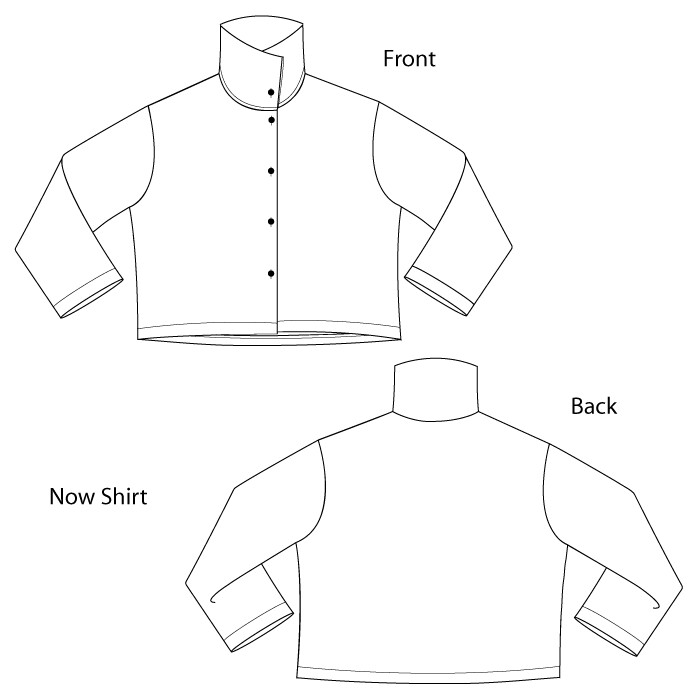
The Now and Zen shirt pattern from the Sewing Workshop is definitely a TnT, or tried and true, pattern. There is almost no fit to it in either view. The Now is shorter and has a *rolled* collar that encloses the raw edges. The Zen is longer, has a center back pleat, as well as a double collar.


While I've made both the Now and the Zen exactly as provided in the pattern, I have more often incorporated aspects of each into a top. 


In this latest make, I used larger of the two collars for the Zen, as well as the center back pleat. But I made it shorter, as I find that is easier to use in layering. I also narrowed the sleeves a bit, and finished them with a bias binding.

The fabric is silk noil, some that I dyed (and overdyed) as part of my wonderful class with Jane Dunnewold, Dye Mastery: From White to Wow. I dyed several lengths of the silk noil, using basically the same approach with each. 

I have learned that dyeing more than a yard is really challenging with this low-water immersion approach to dyeing. In this case, I had a yard, a half yard, and a quarter yard. I only needed the first two pieces, but I kind-of wish I had somehow incorporated the quarter yard. 

The pieces I used tend too much toward yellow, not my best color, especially this warmer yellow. For my next project, I think I'll decide in advance what to make and then rough-cut each piece before dyeing. It will be easier to handle but it does mean the results will have some variety. I think that's OK.

I enjoyed sewing this piece. It is easy to handle in all aspects of sewing. I especially enjoyed the hand-sewing part. I used the running stitch to finish the sleeve hems, the front and back hems, as well as the button bands, and the collar.

Definitely a zen project. And it wears beautifully - very cozy - even if it does make me look a little jaundiced.


Tuesday, August 29, 2023

Sewing, not Seeing, Red

Christmas prints on cotton, some with a little gold sparkle


A dear elderly - that is, older than me - friend keeps cleaning out her stash and giving me quilt cottons. Though my quilting activity is low, my traditional quilting activity is non-existent. Recently she gifted me a stack of red Christmas prints. I said Thank you.


Now I do love red. My dear sainted mother used to say that red is her neutral. When it's cold enough, I wear a long red wool coat bought at Talbot's decades ago in her honor. Red has a special place in my heart.


My local ASG has issued an art-inspred challenge to sew something - anything - inspired by Klimt's well-known Lady in Gold. The story behind the painting, particularly as portrayed in the movie staring Helen Mirren, is riveting and inspiring. I read a bit further about the painting and became curious about the dress the Woman in Gold wears in the painting.

Emilie Flöge shown here with Klimt

Emilie Flöge is the clothing designer behind the beautiful garments worn by those Viennese women in Klimt's colorful paintings. She has a storied past that piqued my interest. She was a companion of Klimt's, a hippie in her own time, a free spirit. Her designs are works of art, detailed, exquisite. 

Back panel


Her personal choice of clothing led to my response to the ASG challenge. I imagine such a linear dress as the one above might have been seen as radical in her own time. And Klimt is dressed similarly. You can see more of her designs here.


I chose a favorite pattern from Folkwear: 104 Egyptian shirt. I have used this pattern at least 4 previous times. There is something appealing to me in its rectangular lines. My most worn version is in an interesting white linen weave. Extended full length, it is called a galabia.

104 Egyptian shirt from Folkwear

By combining so many red prints, my hope was to get away from the Christmas theme. Some of the pieces were 1/2 yard; a few were a full yard. I cut them into 8" x 18" chunks. I created fabric, sort of, by sewing them together along the short ends, making one very long 8" wide strip of fabric. There was no plan to the order in which they were sewn together, except to avoid sewing identical fabrics together.

Center back panel of the Egyptian shirt

I chose the 8" width based on the size of the front and back pieces in the Egyptian shirt pattern. Along the way, I wondered if I needed to break up all that red print, perhaps with something like a black and white print piping. That did not work out - it looked more like Little House on the Prairie than it did Turn of the Century Vienna.

one of the sleeves


This pattern introduced me to the idea of flipping an exagerated facing to the outside of a garment. I have used that idea many times since on tops. I especially like the lines of this particular facing flipped to the outside. It reads exotic. I imagine that Emilie liked exotic. Perhaps this traditional Egyptian look would have appealed to her. 


For the facing, I used a remnant of red silk dupioni, sashiko-stitched in vertical lines. I backed it with cotton batiste. Once I had completed the garment, I thought to check to see how the shoulders lined up. Of course, I needed to do a little after-the-fact sashiko correction.


I added an interior back facing of the red print quilt cotton so that the back side of the cotton print does not show when it is hanging. I am pleased with how it looks hanging on the wall of my sewing room. 


The Egyptian shirt pattern resembles the lines of the Fit for Art Tabala Rasa pattern, another I've used multiple times. It also resembles the Sterling pattern from the Sewing Workshop. Good design is present in all cases. This traditional design includes clever and easy pockets in the side panels. 


My long-term plan for this piece is to use it as a summer weight robe. While at Shakerag this summer, my sweet roomie demonstrated the need for such when she accidentally locked herself out of our room following a shower in the communcal bathroom.


This piece already has a few stories sewn into it.


Friday, July 14, 2023

O'Keefe Coatdress

When this pattern from Diane Ericson was published, I ordered it right away. I have decided that, even if I never use the actual pattern pieces, it's worth the price for all the creative ideas Diane tucks into her pattern instructions. This comes in the form of a spiral bound booklet that is more like a magazine than pattern instructions anyway.

One of many of Diane's samples from this pattern - here it is cropped.

After having such great fun with her French Fold Shrug, I was hungry for another creative adventure with Diane as my muse. And I am somewhat enamored of Georgia O'Keefe. Who isn't? She was such a force of nature during her time, answering primarily to her inner (and outer?) spirit, and not worrying too much about others' opinion of her.


Since I almost never buy fabric for a specific project, I shopped stash for the perfect piece to try this pattern. First though I pulled out an old cotton bed sheet and made a sort-of toile, using the cropped length on the pattern pieces,. This was not to be a wearable toile/muslin.

Use of a toile or muslin has its limits. A bed sheet is usually constructed with a fairly tight weave. This piece is soft due to its age. But it does not mimic my fashion fabric adequately.  I rather liked the way the toile fit through the shoulders and bustline.

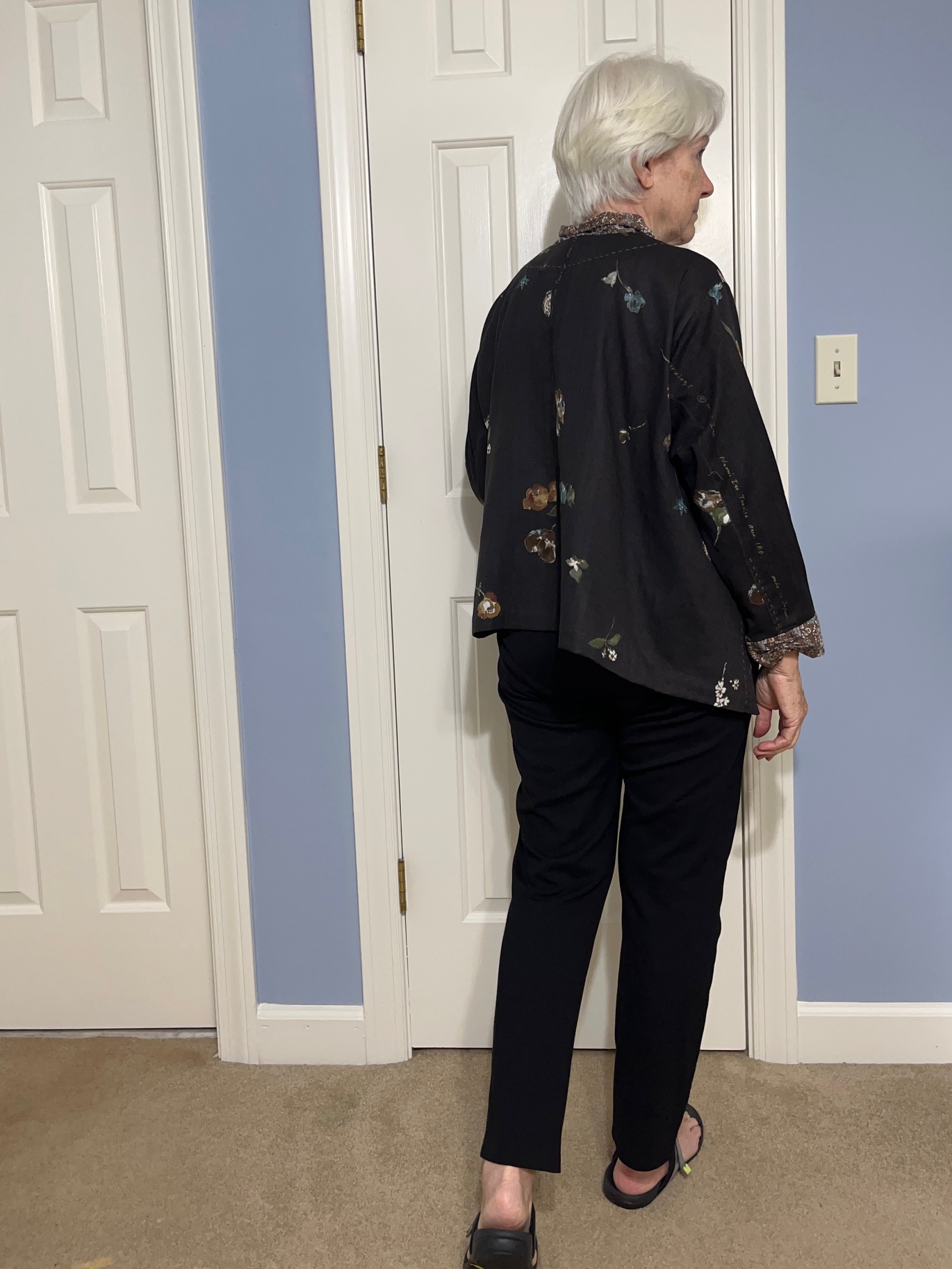
My fashion fabric was in stash but not deeply. I purchased it at Mulberry Silks and Fine Fabrics in NC in early June. It is one of those luscious Nani Iro double cloth gauze wonders. This one is on a soft black background with a light scattering of flowers and leaves. There is also some yummy brown, and even a little touch of shiny gold thread. Beautiful piece.

And of course I had too little fabric. To use what I had as fully as possible, I placed the pattern tissue on it strategically letting the long dress length hang beyond my fabric. This omitted the collar and cuffs which was fine. I had an older cotton lawn from Gail K here in Atlanta that would be good as an accent. The lawn has the same hand as the cotton gauze.

After I basted it all together, I decided the dropped shoulder was not a great look. It was too dropped and, with this soft fabric, there appeared to be no shape to the garment.

I had to cut the back with a center seam and forgot to add seam allowances. You can see where I added in a piece of selvedge with the sweet Nani Iro marks to fix my goof.

Trying to raise a dropped shoulder, after the fabric has been cut, is not for the faint of heart. It requires messing with the side seams and the shape of the armhole and the shape of the sleeve, lots of kludgy after-the-fact stuff. I played around with lapping the side seams as Diane is prone to do. It is a cool technique. 

I omitted interfacing from the collar, as well as the cuffs. I added interfacing to the center front only to support the buttons and buttonholes. I also used a mix of buttons, a la Diane.

I like the finished collar - it's soft like the overall garment. In the spirit of Diane, I folded in in some pleats in the back collar and visibly stitched it down. 

A Diane Ericson sleeve is beautiful. It is one piece but, with the addition of a dart, executes like a shaped two piece sleeve. My final garment does not show this off properly, perhaps again due to the soft fabric. I plan to revisit some patterns that fit me nicely and convert the sleeves so that they hang with this soft curve at the elbow.


One of the interesting aspects of the Diane Ericson sleeve is that it is easy to use when fabric is limited. See my layout above. The only sleeve seam falls along the grainline. The dart mimics an underarm seam.

The bottom of the toile sleeve, which follows the crosswise grain here, shows the effect of Diane's sleeve design.


I think I may do something different with the cuffs. The softness does not work as well there as it does on the collar.

In the end, I sewed ordinary side seams down for about 6" and left the remainder open as a vent. The sleeves were attached in the round and look OK.

Here is the final piece, though Diane recommends that no garment need ever be final. That's a philosophy that resonates with me. Those cuffs are going to change, for sure. 

For now, it is OK.