Showing posts with label TSW. Show all posts

Friday, September 13, 2024

Liberty Shirt Hacks

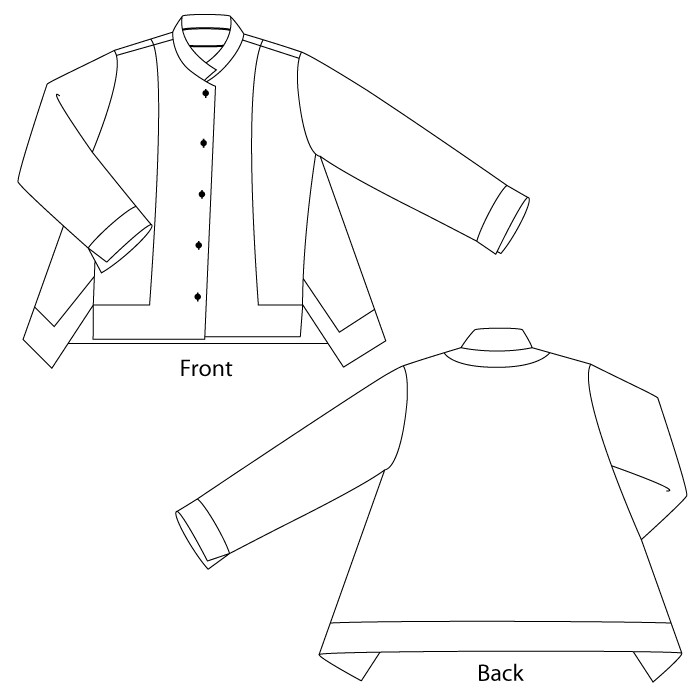
The Liberty Shirt is one of the most popular patterns ever published by the Sewing Workshop. I have noticed that other pattern companies have similar styles, but the one from TSW is my favorite.

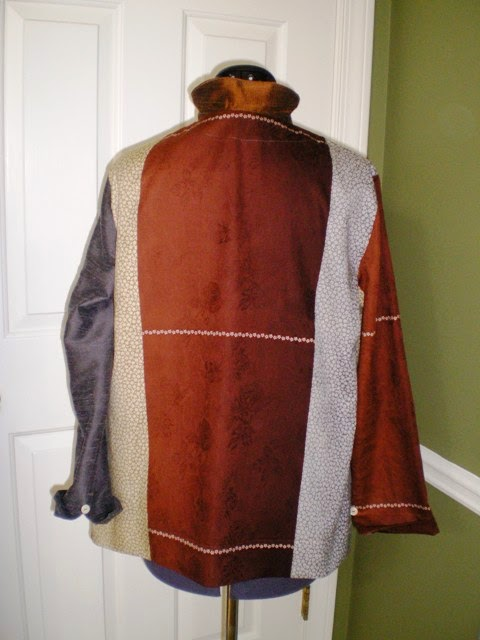
When it was first published, I made this one.
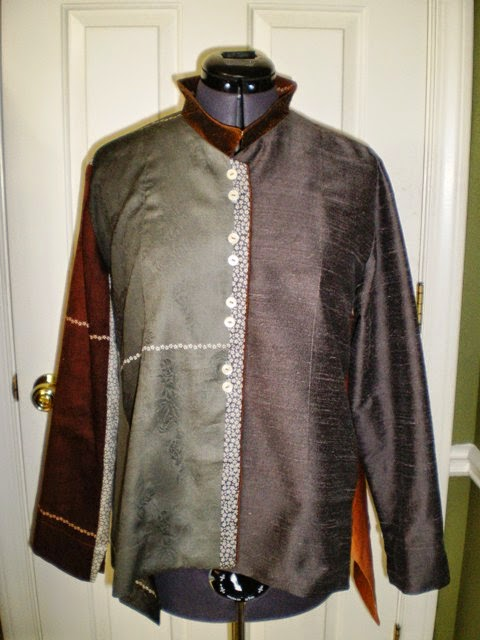

Most of the fabric is a fine Japanese cotton that is printed to look as if it had been pieced. The back shows the original fabric best. It is really one piece of fabric.


As usual I failed to purchase enough fabric for the shirt, so I used solid gray silk dupioni for one sleeve, as well as the left front. I also added tiny burnt orange piping to highlight the wonderful front seams. There are no side seams - the back piece wraps around to the front, creating angled seams where it is sewn to each front. Lastly I spaced my buttons in pairs. Otherwise, I made no changes to it. I loved making it and have worn it quite a lot. 

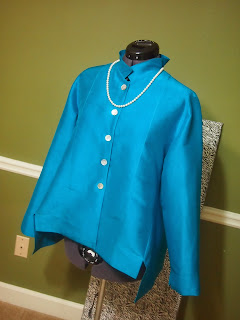
My next one was made in this gorgeous silk shantung. Since it is fancy fabric, I do not wear it as much, but I love the look of it for a dressy occasion, maybe with black silk pants. I made no changes to this one - instead I let the cool design and the striking solid colored fabric shine.

The next time I made it, I used a cotton shirting, cross-dyed in black and white, so it reads gray. This fabric was not fun to sew, as I recall. I behaved like a silk in preserving all areas where I needed to unpick something. And it wrinkles like crazy. I replaced the usual collar with one from TSW's Now and Zen shirt pattern. I used the double collar.


I have made a white version more than once, each with slightly different details. The one below is made in a pretty textured cotton. I created a stand collar to replace the usual one in the pattern.


Evidently I made one in this linen knit. I say, evidently, because I have forgotten all about it. It looks great on the dress form, but I do not like to wear linen knits. They tend to be flimsy and cling to every bump and bubble on my torso. So I expect I gave it away pretty soon after completing it. The significant change in this one was to convert it from a button up top to a pull over. It is such a wonderful color.


The second white shirting version is below. Based on a tutorial from Linda Lee, I used the neckline from the MixIt shirt, omitted the collar, and made the sleeves 3/4 length. It is not visible in the picture, but I added one chest pocket.

My next version was a sweater knit pull-over. I really like this one. The fabric is what Linda Lee calls boucle. It is a wool/rayon blend and a little scratchy. But I always wear it over something else. Other than making it as a pull-over, I made no other changes. I accented those cool front seams with hand-stitch.


My next version was another pull-over, this time in a silk piece with a little lycra. I used black binding to finish the neck and sleeve hems. And I added black piping to the front seams.
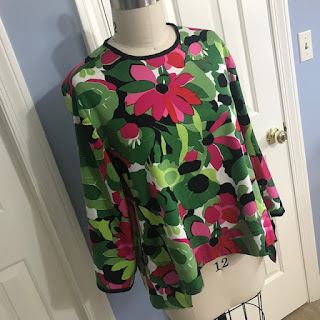

And now, here is my latest.

The fabric is fine Japanese cotton from Nani Iro. It is a double weave and super soft. I bought it on a recent trip to NC. My grandson lives there. The fabulous Mulberry Silks and Fine Fabrics is nearby and a must-see for me.

I accented it with a piece of tana lawn that looks sort-of like Liberty of London fabric. I bought it at the local shop, Gail K, and so I do not really know. The piece was only 36" wide, so I suspect it is not Liberty of London. I have enjoyed using it as an accent on various pieces.


The neckline finish is a variation on the Egyptian shirt pattern from Folkwear. It is a shaped, reversed facing. I also used the tana lawn as a flat piping in the forward seams, as well as for sleeve hem facings.


This fabric has a sweet selvedge. So I hand-stitched that down the back to create a little bit of interest there.


I have already enjoyed wearing this. The Nani Iro fabric is so soft, but the flip side is that it sticks to my high hip fluff. That's OK.

Now I am thinking about my next Liberty hack. I've seen vest versions posted online. And I have a piece of nice fine whale corduroy that would be perfect. 


I suppose there might even be a dress variation left. Or a longish duster. Or. Or. Or.


Monday, September 9, 2024

The Hugo Shirt Lump


I am ridiculously pleased that I finally came up with a fix for the lump at the bottom of the Hugo Shirt from the Sewing Workshop! 

As background, I made the Hugo from linen-rayon white woven fabric about 4 years ago. I liked the finished piece but was never very happy with the finish on the hem at the lower front. I finally wrapped the edge in a self bias strip so that it looked neat, even though it was lumpy IMO.

Original hem fold with serged edge showing

Recently I brushed up against something black. It appeared for about 4 inches around that lump. I tried every cleaning tool on hand. Nothing worked. That black was permanent.

So I put it away to think about. Today I thought about it. I took apart the two fronts from about the waist to the hem. This, of course, meant removing my little bias piece as described above. I set that little piece aside.

My solution to the black stain problem was to cut the hem allowance off, remove the offending black and sew the hem back on, thus making the front slighly shorter than the back. It also introduced a seam along the hem line. I like that, frankly, because it adds a bit more weight to the hem, making it hang beautifully.

And then I began to wonder if there was another way to avoid said lump. Here is what finally worked. BTW, I worked on a sample in parallel with my actual blouse. That way, I could test each step on the sample, then do it on the real garment. The pictures below are the sample, as it pretty clear, I think.

I unstitched the center front seam from the lower edge until a few inches below the lower end of the placket. Next, I pressed the front ham into each side, keeping the left front separate from the right front.

After that, I re-stitched the side seams I had removed in the process of shortening the fronts.

Finally, I folded the lower hem of each front piece into place, and pressed.

With right sides together, I re-stitched the center front seam starting with the lower end of the placket, and stopping at the hem fold line. That point should be lock-stitched.

Then I re-folded the hem for each front piece. With them folded, but not stitched into final position. I placed the two fronts right sides together, aligning all 4 center front edges. Note that there are now 4 layers stacked.

Then, while holding the 3 top layers of the edges together, I wrapped the 4th layer from the bottom, around and over the top layer, creating a sandwich. There are again 4 layers stacked, but it a new order. Note this only works if

1. the lower hems are folded in place, but not stitched, AND

2. the vertical center front seam is finished down to the fold line for the final horizontal hem on the two fronts.

In this position, I stitched all 4 layers together. Then I unwrapped the layer that I had previously wrapped and pressed it all.


With this deep hem, there is nothing poking out and it is easy to press the placket in place.

This creates a beautiful enclosed seam from the horizontal hem fold to the top of the hem allowance. Sooooo exciting, right?!?


Finally I had clip the center front seam right at the top of the hem edge. Now it folds back on itself, forming the most beautiful finished front. Hooray.

I went back to the instructions from the Sewing Workshop. There is a chance that what I have described above is exactly what they intended. Here is the language used, which still does not make sense to me. In any case I plan to tuck my little sample into the pattern envelope in order to save myself a headache on the next Hugo shirt.

With right sides together and facings ou of way, sew Right Front and Left Front at center fron seam. Sew from dot to bottom. Bottom of placket is sandwiched in seam below dot. Clip Left Front seam allowance only to dot. FINISH seam together. Press towards Right Front. 

The key is the making of the *sandwich.* Now, if only I can remember this next time...

Monday, May 27, 2024

Denim separates

These were completed a while back. I love denim for sewing, for comfort, for wearing. Like many my age, I grew up wearing jeans, mostly after I left for college, returning home in my bell-bottom jeans.

The jacket is constructed using a basic kimono approach. I used one continuous piece of denim for the front and back, then two pieces for the sleeves. Lastly, I cut the front up the center, forming an opening and a neckline. I added a strip of denim to the front edge and back neckline to complete the kimono. 

It is very much like the Japanese field clothing hippari (pattern #112), which I have made so many times that I don't pull the pattern out anymore.

I narrowed the sleeves about 6" at the sleeve hems, down to nothing at the shoulder. When I fold the hems back, it will stay in place. And I added nesting pockets.

And then I proceeded to thoroughly enjoy myself stitching sashiko-style designs. So meditative.

I had a smallish piece of heavy cotton painted by Diane Ericson's son, Miles. It became the sleeve facing, the hem facing, and the little pillows at the ends of the cords. I may go back and add ties also on the side seams so I can close it fully and wear as a top.


The pants are made with the Sewing Workshop plaza pants, cropped for warm-weather wear. I'm not seeing it on their website, but periodically they remove old patterns, later to bring them back.

The pants have seams down the center of each leg, and no side seams. At first I thought it might be fun/cool to top-stitch down each side of those seams, sort of sashiko-inspired. But that stitching came out pretty quickly after I finished.

Even though this is sort-of an ensemble, it's unlikely I'll wear them together often.


Sunday, February 25, 2024

E-Vest Re-Make

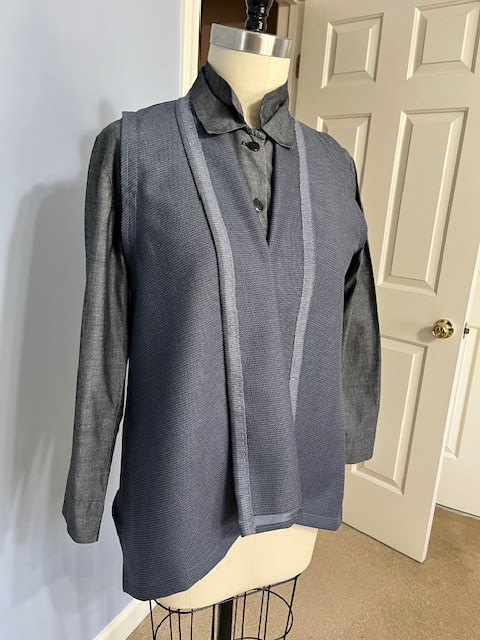
This is a make from last year that I never used as the subject of a blog post. It was perhaps because I wasn't sure I liked it that much. In fact, when I came across it recently I could not remember which pattern I used. At first I thought I had used the Valencia jacket and omitted the sleeves. But, indeed, it was from the Sewing Workshop eVest pattern. And here is why I thought it was the Valencia.


Online description: The easy-to-make eVest is an adaptation of our popular Valencia Jacket pattern. The loose-fitting vest has soft fold-back lapels and angled front drape. The wrong side of the fabric shows. Options for hemming or binding edges are included in the pattern download.

I think that the adaptation is just that the sleeves were omitted. Maybe. The Sewing Workshop folks are champs at reworking a pattern, I think.

I remember it as an easy make, probably from a short cut of fabric I had acquired - too little to make much of anything but a vest. But I like the fabric and NOW I think I really like the vest.

Version 1:


The selvedge was nice looking so I thought I would just fold it back and stitch in place with a running stitch. I used a silk tafeta remnant to finish the armholes and the lower hem.


The result was OK:


Version 2:


Next, I cut off the selvedge down the front and used more of the silk tafeta to finish the front lapels. I also added a patch pocket to the right side front.


Last week I fished it out of the closet and wore it. I love vests when it's cold here. We don't turn the indoor temps particularly high so I like the extra layer. This light weight wool drapes nicely. Also it is not itchy and so I can wear it with almost anything.

I felt like it needed another re-make, so here is the maybe-final...

Version 3:


I removed the silk tafeta binding from the lapels and the front hemline. It is not soft and does not roll nicely even on the bias. I also *improved* some sloppy finishing on the armholes. And I replaced the binding with this rough weave silk piece from stash. 


I have no idea where and when I acquired this piece of silk. It is only 14" wide so probably a kimono remnant I picked up at Sewing Expo years ago. I really like the way the stripes in the bias binding work with the colors of the wool in the vest. Now it is in my rotation of favorite vests.


It goes with a lot of things in my closet. Here I am wearing it with my very old gray silk charmeuse Plaza pants (another Sewing Workshop pattern from years past). 


I think those Plaza pants may have come back into style. Or (more likely), I am just in the mood for loose silk pants.


I did not resist the urge to add a patch to the back neckline.


I am pretty crazy about this eVest pattern now. Maybe I want to make a long version next. It's still chilly here, especially in the mornings.


Saturday, December 16, 2023

Now and Zen Blend

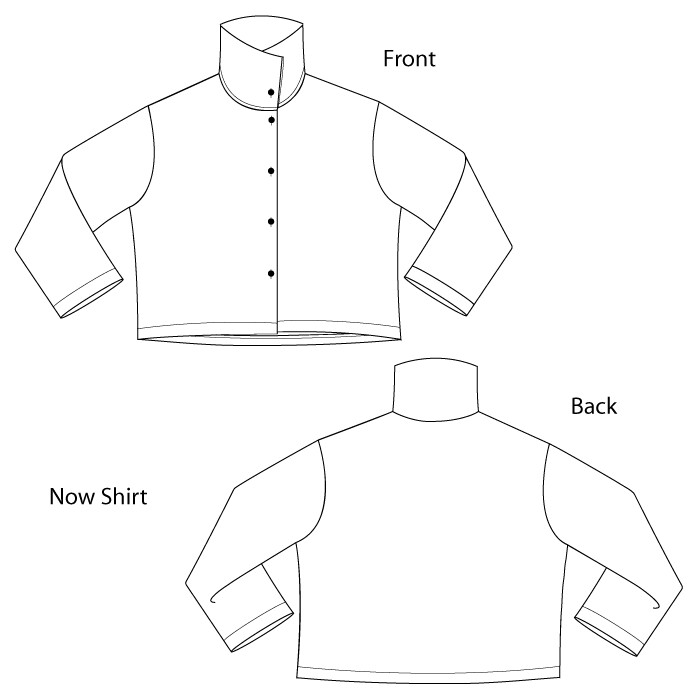
The Now and Zen shirt pattern from the Sewing Workshop is definitely a TnT, or tried and true, pattern. There is almost no fit to it in either view. The Now is shorter and has a *rolled* collar that encloses the raw edges. The Zen is longer, has a center back pleat, as well as a double collar.


While I've made both the Now and the Zen exactly as provided in the pattern, I have more often incorporated aspects of each into a top. 


In this latest make, I used larger of the two collars for the Zen, as well as the center back pleat. But I made it shorter, as I find that is easier to use in layering. I also narrowed the sleeves a bit, and finished them with a bias binding.

The fabric is silk noil, some that I dyed (and overdyed) as part of my wonderful class with Jane Dunnewold, Dye Mastery: From White to Wow. I dyed several lengths of the silk noil, using basically the same approach with each. 

I have learned that dyeing more than a yard is really challenging with this low-water immersion approach to dyeing. In this case, I had a yard, a half yard, and a quarter yard. I only needed the first two pieces, but I kind-of wish I had somehow incorporated the quarter yard. 

The pieces I used tend too much toward yellow, not my best color, especially this warmer yellow. For my next project, I think I'll decide in advance what to make and then rough-cut each piece before dyeing. It will be easier to handle but it does mean the results will have some variety. I think that's OK.

I enjoyed sewing this piece. It is easy to handle in all aspects of sewing. I especially enjoyed the hand-sewing part. I used the running stitch to finish the sleeve hems, the front and back hems, as well as the button bands, and the collar.

Definitely a zen project. And it wears beautifully - very cozy - even if it does make me look a little jaundiced.