Showing posts with label bias. Show all posts

Tuesday, December 5, 2023

'Tis the Season

To be frazzled and overwhelmed, yes? I am trying to manage this more deliberately this season by keeping my expectations low. In pursuit of that, I'll start by admitting that a recent project was less than satisfying.

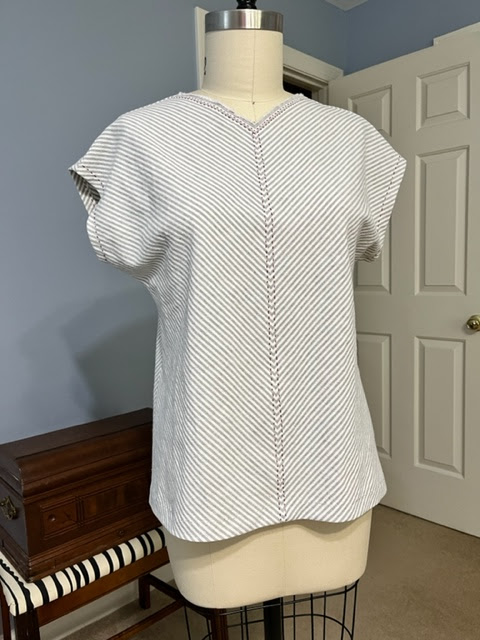
version 2 a.k.a. final version

Diane Ericson's pattern, Fault Lines, has some wonderful details and it's not your everyday ho-hum design. 


As mentioned in several previous blog posts, I am crazy about the sleeves and will most definitely draft that onto the next top I make. By repositioning the underarm seam on the sleeves, and an amazing design for the hemline, the result is elegant. Even though the grainline is similar to most ordinary set-in sleeves, it just seems to hang better.


One front piece and both back pieces are cut on the bias. The other front piece, and the sleeves are cut on the straight-of-grain. I have had some good success with bias but it is not always predictable.


As posted in a previous post, I made the undershirt version of Fault Lines in a light weight linen. Bottom line, it was really too thin to work effectively without something over it. 

I was quite enamored of the trim on the armholes. Sometimes details catch my eye and trip me up. 

that sleeve, oh my.

The main reason this project was faulty was that the fabric was too thin. After talking a bit with Diane about it, I decided to try to retro-fit it with a silk organza lining, similar to one Diane made. The silk organza, really an interlining on hers, gave the shirt just the right amount of weight to work well as a stand-alone top.

version 1 a.k.a. the wadder

Ultimately I gave that idea up. It took me a while to wad it up and put it away, but I'm so glad I finally did so. And then I pulled out a very similar, but heavier linen and remade it with no lining or interlining. I mostly like it.

version 2

The reason for the failure I think emanates from the fact that so much of this piece is bias-cut. Had I started out with it interlined, it might have worked. Or it might have failed in any case.

version 2 worn with matchy-matchy Capitola pants

As I've learned, woven fabrics have two distinct bias grainlines. Depending on the position of the warp thread, it will drape a little differently. Standard advice is to let a partially finished garment hang a day or so to allow the bias to settle into place. I found that helpful, trying to align the two bias pieces - light weight linen and silk organza - sucked the joy out of the project. After way too many hours, I gave up.


Now that I have one wearable top from all the messing around, I am not completely sold on the style. It is different and I have worn it, but...maybe I just wore myself out.


I have to say that I still rate this pattern quite high, and I'll probably make it again. I think it's particularly lovely with both layers, as you can see in my muslin version.

Now, this double layer might have worked with the too-light linen

Meanwhile I am enjoying the colors of the season and have a new project up my sleeve!


Saturday, May 28, 2022

Deep Dive into Bias

Some months ago I volunteered to teach a class on sewing with bias to my ASG neighborhood group, City Wide Couture. I've been clipping articles and pictures and noting websites ever since.

Then I finally took the deep dive into my Threads magazines. Yep, I have physical magazines. Searching for articles on bias can be tricky, as all searching engines are limited. I did find a good one though. Using titles containing *bias* was too limiting. So I searched for the word *bias* and manually eliminated all those that simply contained the word, bias.

Charles Kleibacker Bias-cut Design

I do not have every issue but my filtering yielded plenty. So I began to read and make notes. There were a few articles about Charles Kleibacker and Madeline Vionnet. And Marcy Tilton wrote a number of articles with excellent how-to advice. Other authors touched on it here and there.

Madeline Vionnet Design

In addition I found some amazing videos from the 70's and 80's of Charles Kleibacker such as this one on cutting bias garments. What a treasure. The quality of the film is not what we're used to today and so it took me multiple viewings to understand his approach. Here are some interesting ideas that I had not considered:

  • light drapey fabrics provide *drip* and stable fabrics provide *lift* when cut on the bias. He used this idea strategically in design. Coffin notes that drip fabrics cling to curves and lift fabrics skim the curves. 
  • Avoid cutting until you absolutely must. Some seams can be basted together while the traced pattern is still a part of the yardage.
  • Pattern pieces should be mirrored as you work your way around the body.
  • Through careful thread-tracing and basting, one should *stretch like crazy* while using the sewing machine. 
  • CF and CB seams can be used to create symmetry, if desired.
Very few of the patterns available to home sewers are bias cut. Many contain bias portions. Some even involve cutting and sewing on grain, and then wearing on the bias. But these are not bias cut. Here is an example from Fashion in Harmony.


The Emerald Dress and Top from Made by Rae is one that I have purchased and used. There are very few others that are bias cut, sewn and worn. I blogged on that pattern a while back. The seam allowances for that pattern are only 0.5" but I had no difficulty, and I still love the fit and drape of both garments.


Marcy Tilton maintains that many garments can be cut and sewn on the bias, even though not designed that way. She even shows how to take a basic one-seam pant pattern and do just that in this article: Tilton, Marcy, “Bias Pants,” Threads, Number 116, Dec 2004/Jan 2005, p. 44.

In order to better understand the techniques and ideas I read, I decided to try a simple one on my own. I chose the Eureka Top from the Sewing Workshop. I have made this over and over again size M but it has always run large, so I decided to try a size XS. I decided from the get-go that I would strive to follow the advice given by the gurus but remain practical and true to my own desire for joy.

First I traced the XS pattern from the original tissue and removed the 5/8" seam allowances. Then I used a grid to mark both bias grainlines on the front and back tissues. I wanted a balanced design and so I planned a center front and center back seam on each. I also chose to redraw the neckline so that a V cut fell along the straight-of-grain. It was just too tempting to avoid. As you'll see, I used the selvedge as my neckline edge. I also lengthened the pattern by 4+ inches.

I further reduced the complexity by selecting a piece of yarn-dyed striped cotton that is identical on both sides. Charles Kleibacker recommends that every fabric be cut with nap, and that the right side be marked carefully so as to be consistent in the cutting and sewing. I did not think I needed those extra hurdles here.

Laying the fabric out single layer, I pinned the pattern tissue for 1st front piece and thread-traced on the sewing lines. Then I rough cut it with generous one-inch seam allowances.

Moving the first piece very carefully, I used it to lay out the 2nd front piece on my yardage, again carefully aligning the neckline with the selvedge. Instead of thread-tracing the stitching lines on the 2nd piece, I used transfer paper and traced the seam lines using the 1st front piece as my guide. This is similar to what CK does in his video.

Then, before cutting the 2nd front piece, I basted the center-fronts together at the stitching line. I used the Charles Kleibacker (CK) technique for basting that is also referenced on this blog for Folkwear patterns. I did have to carefully pick up both pieces as I basted to make sure the basted seam lines on the 1st front aligned with the marked seamlines on the 2nd front.

Note that the two fronts must be mirror images of each other. The same is true of the two back pieces. This is due to the fact that there are two bias grains. The two biases will hang differently depending on where the warp and weft threads are located, and will twist as you sew if the pieces are not mirrored. Continue to mirror the grain as you work your way around the body. If there are not CF or CB seams, then be sure that the front piece mirrors the back piece in terms of the bias chosen.

I rough-cut the 2nd front piece, generally following my rough-cut on the 1st front piece. I was anxious to try the CK method of machine sewing bias cut seams. He said over and over again, "Stretch like mad!"

The cool basting technique created enough give in the basted seam to allow me to do just that, stretch like mad. It was fun! I was sure it would fail but I pressed pedal to the metal with wild abandon and sewed with a typical 2.4 mm length straight stitch. 

Next I carefully cut and sewed the two back pieces in the same manner. I must confess that at this point my patience was just barely in check, but I persisted.

After sewing the center-front and center-back seams, I basted first one side seam, and then the next. Again I used the CK method for basting seams so that I could *stretch like mad* at the machine. I followed the same technique for the shoulder seams though I probably did not need to do so.

Then I tried it on. Ta-da! It fit. I could not believe my eyes. It totally fit. And the stripes even matched up creating satisfying chevrons.

At this point, I happily finished all seams with a 3-thread serger. I finished the hemline by simply folding it up an inch and using a running stitch and light gray pearl cotton thread. I finished the armholes by folding under 5/8" and stitching with a contrast pearl cotton thread. I added a bit of that to the neckline, as well as along the CF and CB seams. 

And I have worn it and washed it. No torqueing or stretching occurred.

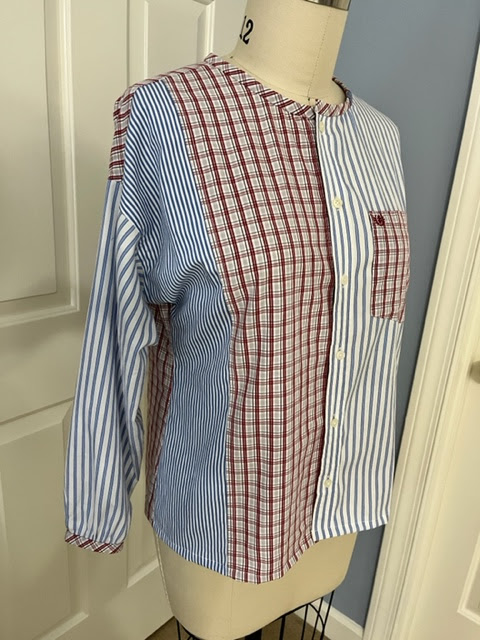
I made another Eureka after this, using thrifted men's shirts with yarn-dyed designs. I want to make a straight-of-grain version that would be very close to this XS one on the bias for comparison. I blogged about this second experimental shirt here

Too bad I did not carefully record the original length of the bias version, but I am convinced that the process did not distort the pattern in any significant way. Here they are aligned on my cutting table. Both have been worn and washed.

How cool is that!

Monday, August 30, 2021

Bias Work - the Emerald Top and Dress


After I read Patti's review of the Emerald Dress and Top, I needed it. It is still hot as Hades here and I do love a linen dress.


This shift dress is composed of 4 panels - two fronts and two backs. This is necessary to in order manage the bias cut. The direction of the bias is mirrored across the front and across the back. It provides a flattering vertical seam down the front and back.

First I made the top in a beefy linen that I thought of as hot pink. DH called it red and it does read red too. After all, what is deep pink if not red? Either way I find it to be a delicious color, and it makes me feel good to wear it. I bought it at my local wonderful Gail K on Cheshire Bridge Road in Atlanta.

Patti made it clear that the top was very cropped. I knew that would not work for me, as my bottom pieces, by and large, have elastic waistbands. This is not a pretty look. Plus I do like a bit more coverage. She added 2" to the pattern pieces and so did I.

It is still a little short at the sides, but not bad. And adding 3 inches might have made it too long in the front and back. The hem is dramatically curved, similar to a man's shirt. 

I love, love, love the drape of bias cut linen. It makes me feel feminine, yet comfy.

Next I pulled out a nicely aged black something-or-other I purchased at my local ASG tag sale a while back. It is at least 60" wide and I think I started with about 4 yards, plenty for the dress. And something else too.

The burn test and the selvedge read rayon, but I think there is something else mixed with the rayon, maybe cotton. It is lightweight, not transparent though. The drape is just right for a bias cut garment, I think. Maybe I said that already. This pattern benefits from some pretty drape.

The dress and the top have deep facings for the armholes, the neckline and the lower hem. These are top-stitched in place adding a nice design detail and serving a good purpose. I especially appreciate the deep hem facing with the light weight black fabric, as it adds some needed weight to the bottom.

The dress includes in-seam pockets and a novel (to me) manner of insertion. It is actually easier than the way I usually insert in-seam pockets. The directions have you attach a single pocket to each front side seam and each back side seam separately. 

Then you align them for stitching of the side seams. I'm not sure the result is as flat as my usual method. This one requires that you press the side seams to the front, something that feels a little off to me.

I am also not thrilled with the finishing on the lower point of the armholes. It finishes nicely on the right side, but not as cleanly on the inside. 

The instructions were not as exacting there as I would have liked. On the top, I just winged it in the absence of specifics in the directions. 

On the dress, I lined up the dots and only stitched between the dots, thinking that might provide a clean finish inside. Ultimately it made no difference. The inside is still a little unsatisfactory.

All of these points are picky, picky. It is a beautifully drafted pattern with clear directions. I think it would be instructive and helpful for even a beginner. 

And I think the shape is just darned nice.


Wednesday, March 21, 2018

Biased, in the wrong direction

For a number of years now, I've paid fairly close attention to grain line in woven fabrics, much more so than when I first started sewing. It's interesting to me that cross-wise grain is different (and more stretchy) than length-wise grain. Today I had a tiny ah-ha moment when I realized that bias actually has two very different directions.

I began to consider this as I wore and enjoyed my most recent Chateau jacket, constructed from a thrifted bedspread. Although each front piece was cut on the same length-wise grain line, the neckline twisted in two different directions. Now that I look back I can see the twisting beginning right after I finished it.


You can just barely see the torque. The left side of the picture shows the corner turning under and the right side shows the corner turning out. Over time it became more pronounced and so it bugged me more. No amount of pressing and steam-setting eliminated the torque.


The neck edge is of course finished with bias binding. So I wondered - was it the bias-binding that was causing the torque? Of course the answer is yes. I tried to draw a picture to help understand how the bias created asymmetry in the front closure. Bias loves to twist and this is how I visualize it twisting in the original neckline.


So I recut the bias-binding. This time I put a seam in the center back of the bias binding. This allowed me to flip one bias piece to mirror the other in terms of the way it wants to twist.


Voila! Mystery solved.

Just for fun, I added a knot at each corner.
I am so easily entertained.